
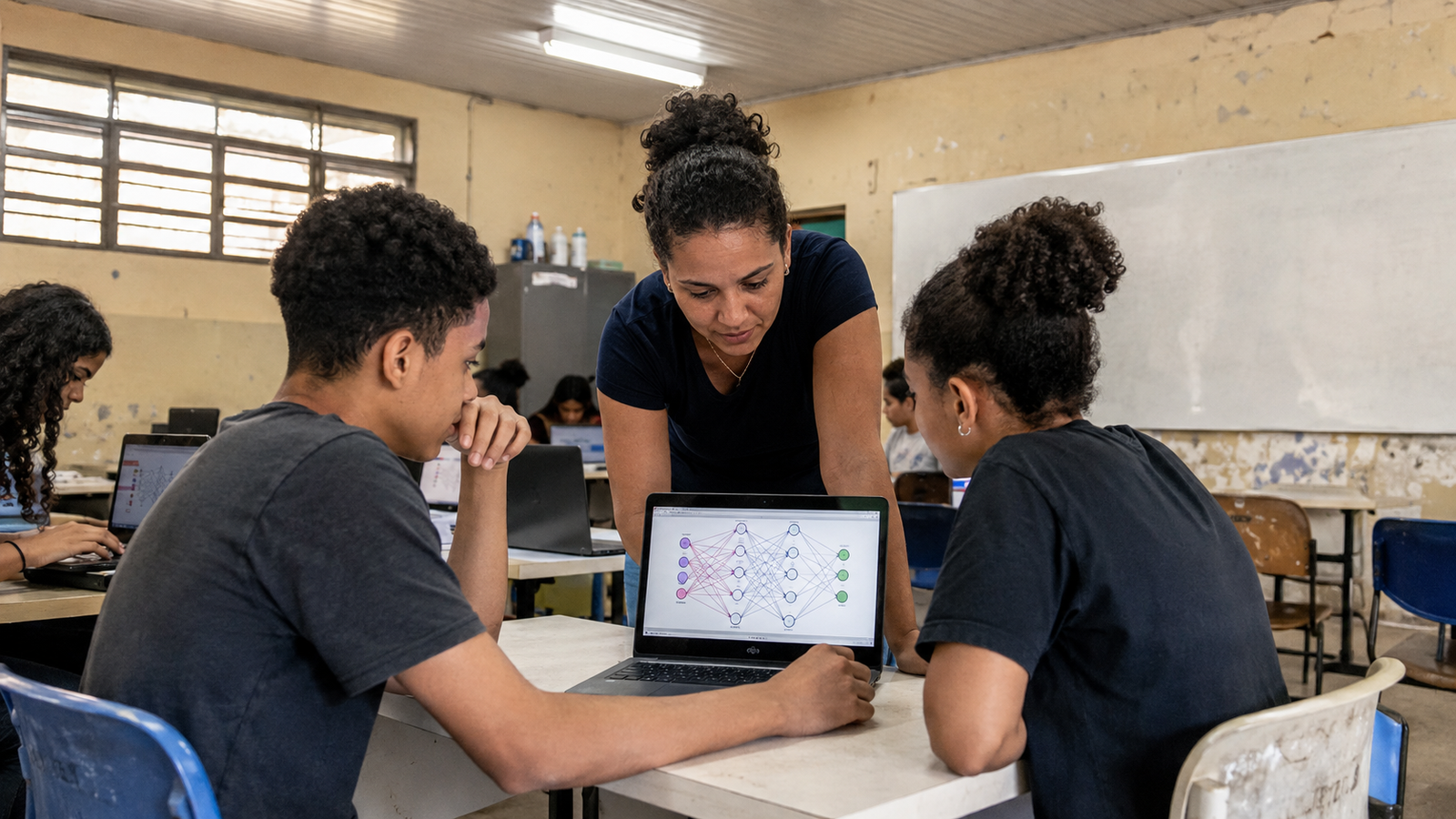
Real AI in real classrooms — a practitioner’s guide to teaching AI and computational thinking in a Brazilian public school. No budget, no shortcuts, no institutional support.
My name is Vanderli, and I teach Mathematics and the technical subjects of a Systems Development track — logic, networks, backend, frontend, version control, mobile — in public schools across the São Paulo municipal and state networks. I hold degrees in Mathematics, Computer Engineering, and Environmental Chemistry from the University of São Paulo (USP), and I run a physical Digital Education Laboratory (LED) where AI, robotics, and computational thinking stop being slideshow topics and become things students build with their hands.
This is not a theory of how AI should be taught. It’s a report from a teacher actually doing it — in the conditions most ed-tech content never mentions: limited bandwidth, no institutional AI budget, secondhand hardware, and a curriculum written before generative AI existed.
Why Most “AI in Education” Content Doesn’t Apply to Real Classrooms
Khan Academy, Google for Education, Coursera
Reality check: Polished, well-funded, largely irrelevant to a teacher deciding whether to spend her own money on a Raspberry Pi.
This content assumes infrastructure — reliable internet, one device per student, institutional licenses — that most public schools worldwide do not have.
AI Influencers & Tool Roundups
Reality check: Sound advice in the abstract, untested against real classroom friction.
They teach about AI — prompting techniques, productivity tips — without ever having stood in front of 35 teenagers who don’t want to be there on a Friday afternoon.
The Third Space
Best for: Teachers who need methods that actually survive contact with a real public-school classroom.
A teacher-researcher with rigorous technical training (USP) who implements AI, robotics, and computational thinking in a real public school — and documents what actually works.
Platforms don’t have the practice. Creators don’t have the training. Academics don’t have the public school. This space has all three.
The Foundation: Computational Thinking Before “AI Literacy”
The single biggest mistake in AI education content is starting with the tool instead of the thinking. Before my students touch a chatbot or a machine learning model, they spend weeks building decomposition, pattern recognition, abstraction, and algorithmic design.
A concrete example: before introducing any AI concept, my students play chess — not as a side activity, but as a deliberate pedagogical tool. Chess forces explicit if-then reasoning and evaluation of trade-offs under constraint. It requires almost no infrastructure — a physical board, or a free browser simulator, is enough.
What Teaching AI Actually Looks Like, Week to Week
Structured Instructional Materials
Pattern: Conceptual foundation → concrete tool → applied mini-project → clear Definition of Done.
This consistency matters more than any single brilliant lesson, because it survives a chaotic school week.
Self-Contained, Offline-First Tools
Standard: Single-file web applications — no external dependencies, no server requirements, runs on a five-year-old laptop.
Simulators covering functions and logic, network layers (OSI model), fractions with audio narration, and a full chess platform with sequential missions — all built without a budget.
Curriculum Alignment
Rule: Every activity gets validated against official learning-cycle standards before reaching students.
A dazzling AI demo that teaches nothing mapped to the curriculum is a magic show, not education.
Relentless Documentation
Why: Documentation turns one good lesson into a repeatable system — the only thing that scales when you are the entire ed-tech department.
Infrastructure Reality Table
| Constraint | Standard Response | Why It Works |
|---|---|---|
| No AI budget | Free, low-cost, or self-built tools only | Default condition, not exception |
| Unreliable internet | Offline-first, single-file tools | No live API dependency during class |
| Aging hardware | Lightweight, no-install web apps | Runs on five-year-old laptops |
| No dedicated AI period | Integrated into Math and Systems Dev | Fits the existing timetable |
| One teacher, every role | Templates and reusable standards | Survival tool, not nice-to-have |
From Function Machines to Neural Networks: A Concrete Case
I built a browser-based “function factory” simulator — students manipulate visual input-output machines to understand what a mathematical function does before ever writing code. Single self-contained web page, no installation, no internet dependency once loaded.
Once students grasp “input goes in, a rule transforms it, output comes out,” the leap to explaining a neural network becomes dramatically easier: a neuron is just a function machine with adjustable weights, and training is just the machine adjusting its own rule until the output gets closer to what you wanted.
Where to Start Without Feeling Overwhelmed
Don’t try to build everything at once. That’s a guaranteed path to burnout.
Instead, pick one starting point based on where you are:
- No budget at all? Start with chess and logic puzzles — zero cost
- Have a computer lab? Build one offline-first simulator this month
- Need administrator buy-in? Map one activity to your existing curriculum standards
- Teach Math or STEM? Start with the function-machine-to-neural-network sequence
- Overwhelmed by documentation? Document just one lesson this week, fully
Once you’re comfortable with one piece, adding the next feels natural — not overwhelming.
Frequently Asked Questions
Do I need coding experience to teach AI concepts?
No. Computational thinking — decomposition, pattern recognition, abstraction — can be taught through chess, logic puzzles, and visual tools before any code is written.
How do I justify AI activities to a principal unfamiliar with the term?
Map every activity to standards your school already requires. Content that floats outside mandated curriculum gets cut the first time the schedule compresses — and it always compresses.
What if my school has no internet or device budget?
Build offline-first, single-file tools that run once loaded, on secondhand hardware. This is the actual operating condition for most of the world’s classrooms, not an edge case.
Is this approach specific to Brazil?
No. The methods are built for resource-constrained public schools generally — they transfer to any context with limited budget, unreliable connectivity, and a single teacher wearing every hat.
Final Thought
The dominant narrative around AI in education assumes top-down delivery: platforms, licenses, institutional rollouts. For most of the world’s students, that rollout is not coming on any meaningful timeline. What’s available to them depends on what one teacher builds with the time and tools she actually has.
That’s not a lesser version of AI education — it’s often a more rigorous one, because every tool has to justify itself against “does this work in this room, today, with this hardware,” not a marketing slide.
Want the tools, templates, and lesson structures as they’re built?
Join teachers from around the world applying AI in real, resource-constrained classrooms — not just reading about it.