
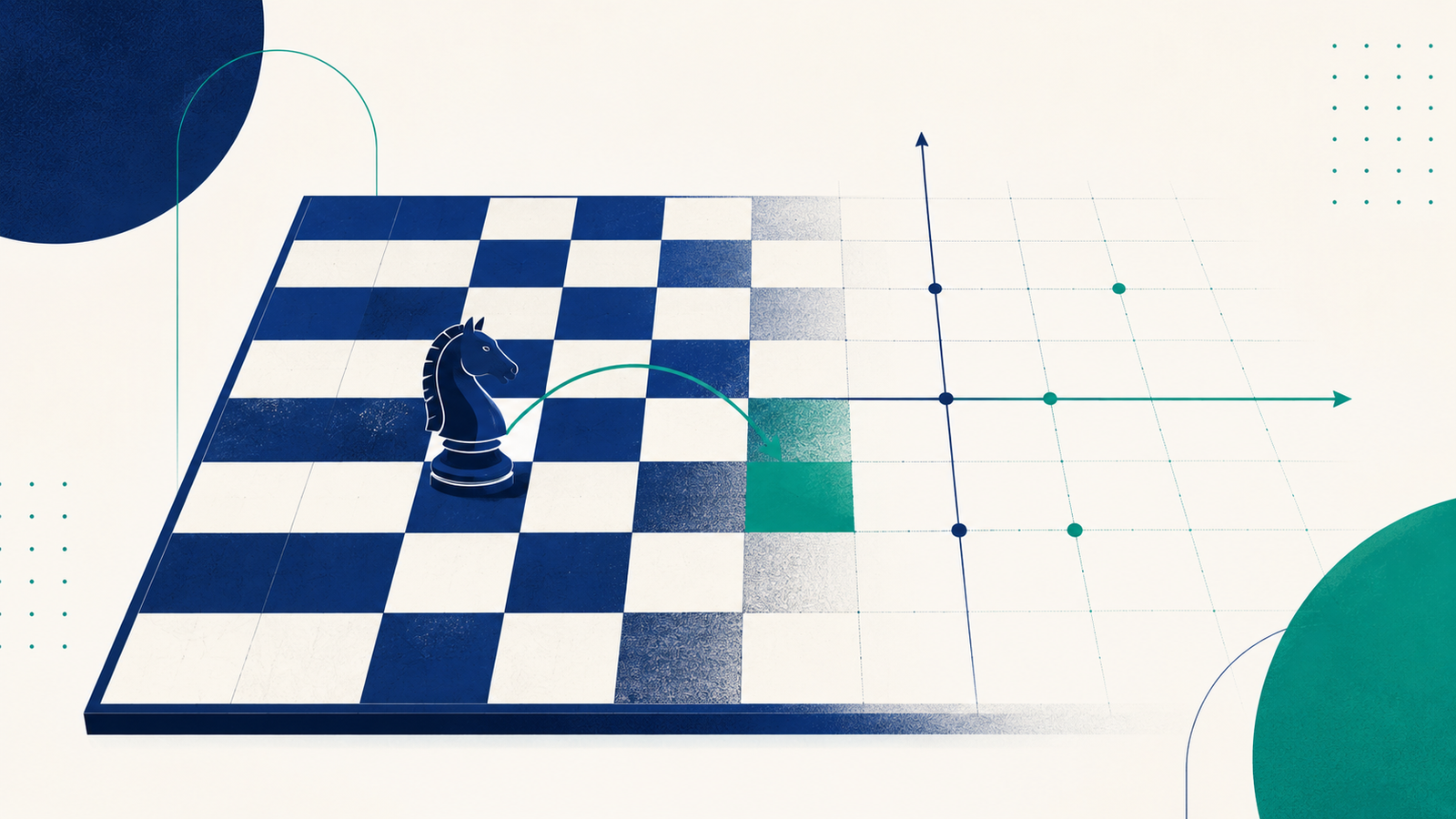
Chess doesn’t make children better at math because it’s chess. It works — when it works — because of three specific cognitive mechanisms, and most school chess programs use none of them deliberately. Here’s what the evidence actually supports, and how I run it in a Brazilian public school with a chessboard, no budget, and thirty minutes a week.
I teach Mathematics in a Brazilian public school network and run chess with students as part of the same lab where I teach computational thinking, robotics, and — increasingly — AI literacy. This isn’t a piece arguing chess is magic. It’s an attempt to separate what the evidence on chess and cognition actually supports from what gets claimed in grant proposals, and to show three structures I run every week that target the mechanisms worth targeting.
Why “Chess Improves Math Scores” Claims Don’t Survive Scrutiny
Correlation Presented as Causation
Reality check: Students who join a voluntary chess club already tend to be higher-achieving, more supported at home, and more willing to sit still for forty minutes.
A test-score gap between chess-club kids and everyone else tells you almost nothing about what chess did. It tells you who opted in.
Transfer Assumed, Never Taught
Reality check: Playing forty games of chess does not automatically hand a student the skill to solve a fraction problem. Transfer between domains has to be built, not hoped for.
A student can be a strong tactical player and still not connect “I calculated three moves ahead” to “I can estimate before I compute” unless someone draws that line explicitly.
Target the Mechanism, Not the Game
Best for: Teachers who want chess to earn its place in a crowded curriculum, not just occupy an enrichment slot.
Chess plausibly supports three specific things: visual-spatial pattern recognition, structured decision-making under constraint, and tolerance for a wrong move that costs something. Programs that name and train these directly get more out of the game than programs that just play it and hope.
What the Research Actually Supports — Stated Carefully
The literature on chess and cognitive transfer is mixed, and any honest account of it has to say so upfront. Meta-analyses generally find small-to-moderate effects on visual-spatial and general reasoning tasks, effects that shrink considerably once study quality and control-group design are accounted for. What survives that scrutiny most consistently is narrower than “chess makes you smarter”:
Visual-Spatial Pattern Recognition
Reading a board — seeing that a diagonal is open, that two pieces defend the same square — is a spatial-relational skill with a plausible link to geometry and to reading coordinate grids. This is the strongest and most replicated part of the evidence base.
Structured Decision-Making Under Constraint
Every legal chess move is a decision made inside a fixed rule set with a visible cost. That’s close to the discipline mathematical estimation requires: choosing an approach, committing, and being willing to revise when the numbers don’t work out.
Tolerance for Productive Failure
Losing a piece to a move you can trace back to exactly one bad decision, then playing again, builds a specific kind of resilience — the willingness to attempt a problem you might get wrong, which is the single biggest classroom obstacle to math confidence.
What the evidence does not reliably support is a general boost to computation fluency or standardized test scores from chess exposure alone, without deliberate bridging to the math content. If your program’s justification stops at “chess improves math,” it’s overclaiming. If it names which of these three mechanisms it’s targeting and how, it’s on solid ground.
Integrating Chess Into a Real, Resource-Constrained School
Most schools that try chess integration fail for infrastructure reasons before they fail for pedagogical ones. Here’s what I’ve had to solve for in a public school with no dedicated chess period, mixed-age classes, and a shared, unreliable computer lab.
| Constraint | Standard Response | Why It Works |
|---|---|---|
| No dedicated chess period | 10–15 minute segments inside existing math class | Ties chess directly to the concept being taught that day instead of competing with it |
| Not enough physical boards | One board per four students, rotating roles (player, player, two analysts) | Analysts narrate the reasoning out loud — the skill lives in the narration, not just the moves |
| Mixed skill levels in one class | Puzzle-of-the-day format: same position, different depth of question per group | Everyone engages with the same board; the cognitive demand scales, not the equipment |
| No reliable internet | Physical boards and printed positions, digital tools as occasional bonus | The lesson never depends on a connection that might not be there |
Three Classroom-Ready Structures
Coordinate Hunt on the Chessboard
Before introducing the Cartesian plane, I use the chessboard’s own coordinate system (a1 through h8) as the bridge. Students locate pieces by coordinate, then predict which squares a piece attacks — the same logical structure as plotting points and reading a function’s domain.
The Three-Move Algorithm
Older students write an explicit, precise sequence for the first three moves of a chess opening — precise enough that a non-player could execute it from the text alone. This is the same algorithmic-thinking skill used to write out the steps of a math procedure, made concrete because a wrong instruction produces a visibly wrong board.
Losing Piece Post-Mortem
After a game, before moving on, each student writes one sentence: which move caused the loss, and what they’d estimate the cost was in material value. This turns an emotional loss into a structured estimation exercise and normalizes revising a strategy mid-problem.
Where to Start This Week
- Pick one mechanism, not all three. Coordinate reasoning is the easiest entry point if your students are already learning the Cartesian plane.
- Steal ten minutes, don’t ask for a new period. A chess segment survives in a crowded curriculum only if it rides inside a lesson that already exists.
- Make the bridge explicit out loud. Say the sentence connecting the chess move to the math concept — students rarely make that leap unprompted.
- Keep a puzzle-of-the-day rotation. One board, one position, projected or drawn on paper, works for a class of thirty with zero additional equipment.
Frequently Asked Questions
Do I need to be a strong chess player to teach this?
No. These structures target reasoning and vocabulary, not competitive strength. Knowing how the pieces move and being able to read a coordinate is enough to run all three activities.
What age range does this work for?
The coordinate hunt works from around age 7 once students can read a grid. The three-move algorithm and post-mortem structures work best from age 9 up, when students can hold a short written sequence in mind.
How much class time does this actually take?
Ten to fifteen minutes, folded into an existing math lesson. None of the three structures needs a standalone period once students know the routine.
What if some students already play competitively and others have never touched a board?
The puzzle-of-the-day format handles this directly — the same position supports a basic “what piece is attacked?” question for beginners and a “find the best move and justify it” question for advanced players.
Is there research backing the specific link to coordinate geometry?
The strongest, most replicated finding in the chess-cognition literature is the visual-spatial one — chess reliably correlates with spatial reasoning tasks even after controlling for who chooses to play. Coordinate geometry is a spatial-relational skill, which is why that bridge is the most defensible starting point of the three.
Final Thought
Chess earns a place in a math classroom the same way any other tool does: by targeting something specific and being honest about what it doesn’t do. It won’t raise a test score by itself. It will, reliably, give a student thirty extra minutes a week of reading a spatial structure, making a constrained decision, and recovering from a costed mistake — three things every math classroom needs more of anyway.
If you teach in a school with one chessboard, thirty students, and no dedicated period, that’s still enough to start.
Want the puzzle-of-the-day templates and lesson structures as they’re built?
Join teachers from around the world applying chess, robotics, and AI in real, resource-constrained classrooms — not just reading about it.